
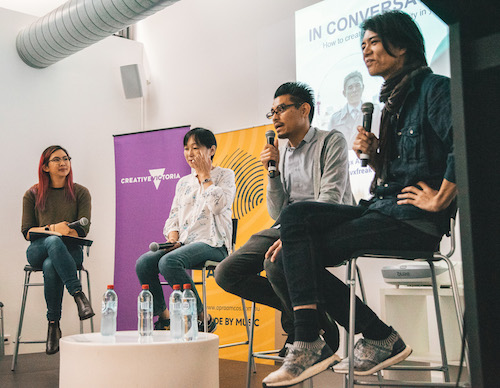
This time I will be talking about the event in Melbourne that I recently attended.Games WeekThis will be a report. First, I took the stage as a Keynote Speaker and also participated in a panel discussion.High Score 2019From an event specializing in game audio. High Score has become a gathering place for emerging game developers in Melbourne in recent years.The ArcadeThis is an exchange event held at a workplace organized for non-profit purposes. The Arcade's concept is an environment to enable easy and frequent interaction between business ventures, similar to the Cambridge Innovation Center (CIC) in Boston and Level39 in London.
The area on the south side of Melbourne where The Arcade is located is quite different from the atmosphere in the center, with no skyscrapers, buildings or shops clearly for tourist purposes, and a calm yet emerging area reminiscent of a new business setting up. Compared to Sydney, real estate prices here have not yet skyrocketed compared to Sydney, and rents have been kept low.Furthermore, the state of Victoria has provided subsidies to the game industry as a growth industry, and many startups from all over Australia, as well as many game-related creators looking for business opportunities, are moving here.Not only the atmosphere of the city, but also the business environment is very similar to the old Brooklyn and Berlin, making it a city that foreshadows future growth.
What is the content of your Keynote Speech?previous blogUsing this as a reference, the overall atmosphere of High Score is like a homey, miniaturized version of GDC that specializes in audio. However, when I asked the audience at the beginning of my speeches and discussions, I found that a large percentage of them were students who wanted to work in the game industry, and when I asked questions after the stage and actually spoke during stand-up conversations, I found that many of the students had not only majored in music composition in college, but had also studied technical expertise in digital audio and marketing in the industry, and even had one who had already gained tens of thousands of subscribers on a YouTube channel where he releases his own music. However, he still seems to be trying through trial and error to figure out how to get a chance as a composer in the game industry. There were also quite a few participants from countries such as the United States and Canada, which made me realize how intense competition has become in the game industry in recent years.
During the three days during the High Score period, I had two presentations on stage, a game-related web radio show and an ABC (Australian Broadcasting Corporation) program, and in addition to the networking party after the event, I was also invited to a home party at the organizer's house and a party on the ship, where we had a lot of interesting exchanges of opinions. In particular, at the house party, I had a very interesting conversation with a strategist in the game music rights business and an audio coordinator for a major online game developer who came from America (although I can't really tell what they do exactly just by their titles ^^;). Regarding the rights to game music, ASCAP, an American copyright management organization, allows registration of individual songs rather than individual authors, depending on the conditions, and Japanese game composers have already avoided JASRAC and joined overseas PROs, allowing them to manage their own songs better than before. I heard about a case in which they were able to both obtain an order for a transfer contract in Japan (although I thought this was still a difficult problem as the scope of rights changes complicatedly depending on individual conditions).The audio coordinator also talked about strategies regarding division of labor within a project and effective and efficient sharing of information. Also, all of them and the host of the home party that invited me this time (he is the owner of two game music labels and a production company) originally had a background as composers, so I was impressed by the fact that they not only have a love for music, but also have an understanding of the actual production environment and have successfully built skills in their current specialized fields.


Well, this time on High Score, we will introduce composers from Japan who have been active in the game industry since the Famicom era.Manami MatsumaeMr. Matsumae and I had been invited, and in contrast to myself, who gave a presentation-style speech using Keynote, Mr. Matsumae's style was quite simple, reading out a text that described his great career and only explaining the important points using reference sound sources. Mr. Matsumae started by speaking in Japanese and then translated into English with an interpreter, which I thought would be okay since it would get monotonous, but the audience really listened intently to every word that Mr. Matsumae said. Many of the audience members were students and young composers, and I think they heard the words of Mr. Matsumae, who has been providing music since the beginning of the game, as some kind of ``words of God.'' With such a difficult and highly competitive environment in which it is difficult to enter the game industry, it seemed like these young people were trying to get some hints from the ``Word of God.'' At the same time, it was a sight that made us realize the weight of the history of the Japanese game industry, which created the genesis of games, and its strength as an asset that still has a strong influence.
to be continued